Oil Prices Fall as Iran Deal Eases Global Supply Fears
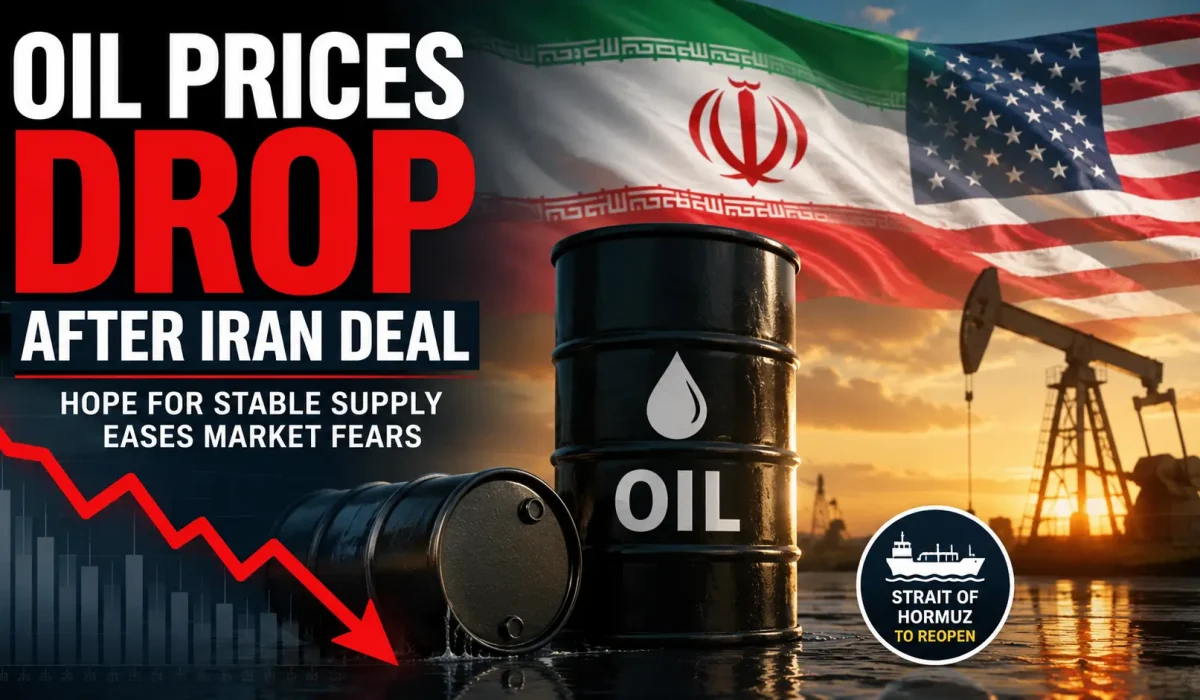
Global oil prices dropped sharply on Monday after the United States and Iran announced a preliminary agreement aimed at ending months of conflict and reopening the strategically vital Strait of Hormuz.
The breakthrough sparked a rally across global financial markets while sending crude oil prices to their lowest levels in months as traders anticipated the return of normal energy flows through one of the world’s most important shipping routes.
Why Oil Prices Are Falling
The primary driver behind the decline is the expected reopening of the Strait of Hormuz, a critical waterway through which roughly one-fifth of the world’s oil supply normally passes.
During the conflict, disruptions to shipping routes and concerns over supply shortages pushed oil prices dramatically higher, with Brent crude previously surging above $120 per barrel at the peak of the crisis. The new agreement has significantly reduced fears of a prolonged supply shock.
Brent Crude and WTI Post Major Losses
Following news of the deal, Brent crude fell approximately 5%, trading near $83 per barrel, while U.S. West Texas Intermediate (WTI) crude dropped more than 5%, briefly falling below the $80-per-barrel mark for the first time in months.
Analysts say markets are rapidly pricing in the possibility of increased oil exports from the Persian Gulf and the gradual normalization of shipping traffic through the region.
Stock Markets Rally on Energy Relief
The decline in oil prices provided a boost to global equities. Investors welcomed the prospect of lower energy costs, reduced inflationary pressure, and improved economic stability.
Major stock indexes across the United States, Europe, and Asia posted gains as investors reacted positively to the possibility of a lasting ceasefire and the restoration of global energy supply chains.
What the Iran Agreement Includes
According to reports, the preliminary agreement would extend the ceasefire between the United States and Iran and pave the way for the reopening of the Strait of Hormuz. Officials from both sides have indicated that a formal signing ceremony could take place later this week, though some details remain under negotiation.
While markets have reacted positively, analysts caution that the agreement still faces implementation challenges, including security concerns and unresolved issues surrounding Iran’s nuclear program.
What Lower Oil Prices Mean for Consumers
If crude prices remain lower, consumers could eventually see relief at the gas pump. Lower energy costs also help ease inflation pressures that have weighed on households and businesses throughout 2026.
Transportation, manufacturing, and airline sectors are among the industries expected to benefit most if oil prices continue to retreat. Investors are now watching whether the ceasefire holds and whether commercial shipping fully resumes through the Gulf region.
Outlook for Oil Markets
Despite the sharp sell-off, uncertainty remains. Energy analysts warn that any disruption to the agreement or renewed tensions in the Middle East could quickly reverse recent declines.
For now, however, traders are betting that the worst of the supply crisis is over. With the Strait of Hormuz potentially reopening and millions of barrels of oil expected to return to global markets, oil prices are experiencing their largest decline in months.
Key Takeaways
- Oil prices fell more than 5% after news of a U.S.-Iran agreement.
- Brent crude dropped to around $83 per barrel.
- The Strait of Hormuz could reopen in the coming days.
- Global stock markets rallied on lower energy costs.
- Analysts remain cautious until the deal is formally signed and implemented.
As markets continue to digest the news, the Iran deal could prove to be a major turning point for global energy prices and inflation heading into the second half of 2026.